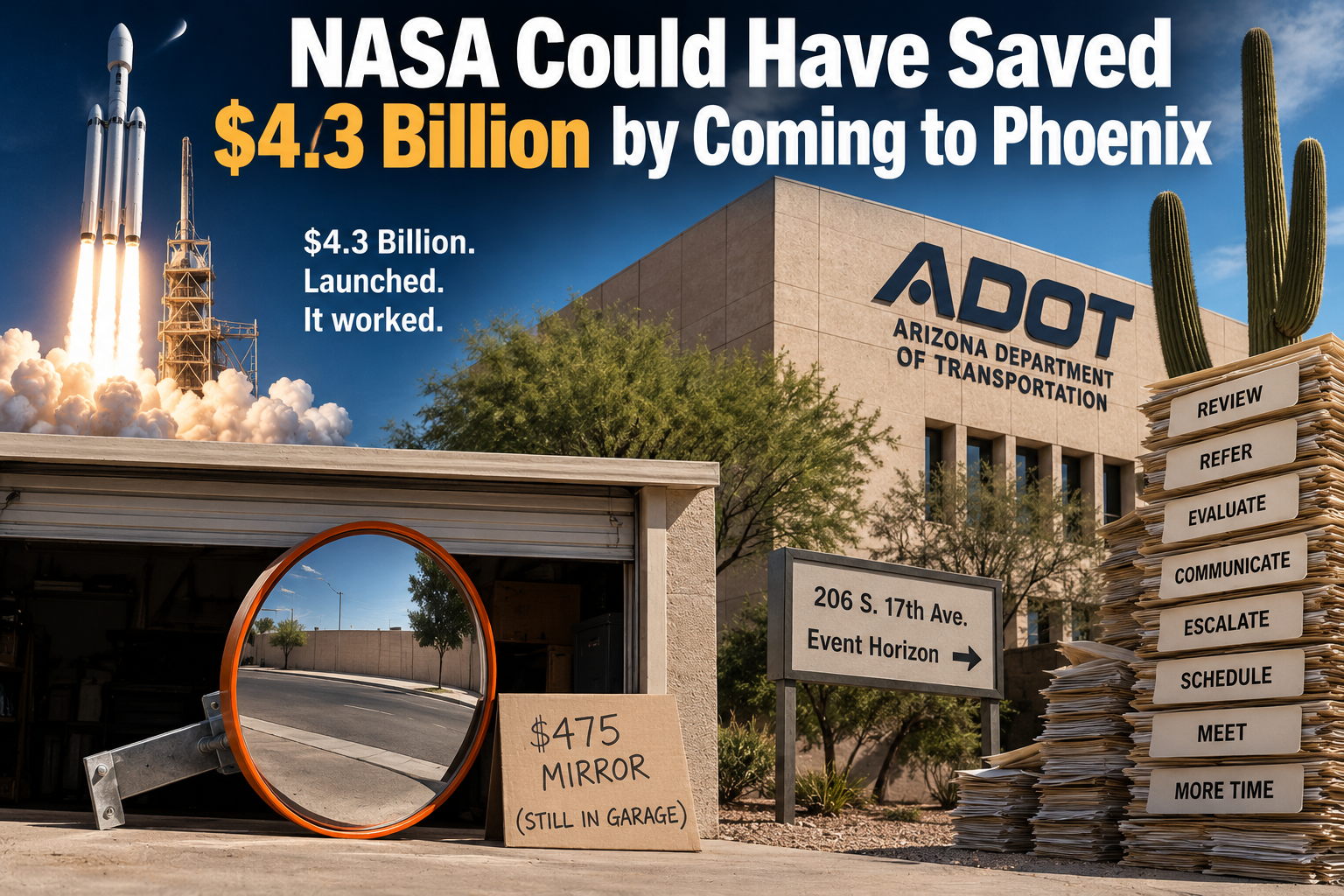
On August 30, NASA launched the Nancy Grace Roman Space Telescope from Kennedy Space Center aboard a Falcon Heavy rocket.
Roman cost about $4.3 billion.
NASA launched it.
It worked.
I wish somebody at NASA had called me first.
I could have saved them a lot of money.
There is a black hole in downtown Phoenix. It is operated by the Arizona Department of Transportation. We discovered it accidentally while trying to install a $475 mirror.
The Experiment Begins
I live in a neighborhood near Black Canyon Highway in Phoenix. Leaving the neighborhood westbound on Corrine Drive requires entering the highway while watching for northbound traffic that can be difficult to see soon enough to make the experience entirely relaxing.
A neighbor had an idea. Put up a convex traffic mirror. There is a sound wall opposite the entrance. A properly positioned mirror would give drivers another view of approaching traffic before they entered the roadway.
Our Block Watch had received a City of Phoenix grant that included $1,200 for the project. We found the mirror we wanted for $475, including shipping. Southwest Barricades estimated another $575 to install it, including $75 to prepare the required plan and diagram.
Total anticipated cost: about $1,050. This seemed like a relatively simple undertaking.
That was our first mistake.
In June 2025, I contacted ADOT to ask who we should talk to about getting the ball rolling. About two weeks later, the answer arrived. We would need an encroachment permit. Along with the application came four additional documents explaining how to complete it.
I read them. Then, being a modern fellow, I gave the application and instructions to a large language model. These systems can write software, analyze financial statements, translate languages and explain quantum mechanics.
It couldn't figure out how to complete an ADOT encroachment permit.
So I assigned another AI model to research the problem.
It couldn't figure it out either.
This seemed an appropriate moment to try an older technology: a human being. I emailed ADOT and asked whether I could meet with somebody who understood the application and could explain what the department needed. I was told a meeting wouldn't be necessary. This was a simple request. We should do the best we could, submit the application, and the department would review it.
This Advice Would Become Important Later
The application required more than an application. We needed a diagram showing precisely where the mirror would go. We needed proof that the neighborhood carried adequate insurance. We needed proof that the contractor carried adequate insurance. We needed a traffic-control plan. We needed mounting information and product specifications.
Remember, the mirror cost $475.
Still, none of these requirements was individually unreasonable. People work beside highways. Governments have rights-of-way to protect. Contractors need insurance. Traffic needs to be controlled. So we assembled the package. Then we tried to email it. The email bounced.
What followed was a series of exchanges with an unidentified person who addressed me simply as “Sir.” Eventually we determined that the security features of my Proton email account were interfering with ADOT's security system, which needed to inspect the incoming material before allowing it farther into the organization. This also seemed reasonable. One cannot be too careful when someone is attempting to transmit a traffic mirror application into a state transportation agency. Eventually we penetrated the electronic perimeter.
On April 7, 2026, ADOT notified me that it had received our application and forwarded it to the permit technician assigned to review it. Eight days later, the permit technician emailed me.
He needed the documents required to begin processing the application.
These were the documents we had submitted with the application.
This was my first indication that we might not be dealing with an ordinary government agency. Information had entered ADOT. ADOT had officially acknowledged receiving the information. ADOT had forwarded the application farther inside. But the information accompanying the application had disappeared.
Physicists have a term for a boundary beyond which information cannot return to an outside observer.
They call it an event horizon.
We sent everything again. Six documents this time, individually identified, including the permit application, site plans, installation information and contractor materials.
Initial Review
On June 9—approximately a year after our first inquiry—the assigned technician sent the result of his initial review. He could not permit the request because of “the liability that installation of a mirror in this location creates.” He didn't identify the liability. So I asked.
If this was a formal denial, I wanted to know the authority supporting it, the factual basis for the decision and the appeal procedure. If it wasn't a formal denial, I wanted to understand the liability and whether it could be mitigated.
This produced progress. We were going to have a meeting. Readers with good memories may recall that I had asked for a meeting near the beginning of this process, when neither I nor two artificial-intelligence systems could determine how ADOT wanted the application completed. A meeting wasn't necessary then. The matter was simple.
A year of processing had finally made it complicated enough to require one.
The Meeting
By this point I had complained to the director responsible for the permitting operation. His response was refreshingly candid. The office was short a supervisor and two team members. This was an unusual request. The people handling it hadn't known what needed to be done. We had received some bad information.
And a pre-application meeting was indeed needed. The director said the technician would be taken into the field before the meeting so they could put some eyes on the intersection and understand our concern. That didn't happen. I don't know why.
Presumably he had a meeting.
On June 18, six ADOT employees assembled with Frank Martinez from our Block Watch, Jeff from Southwest Barricades, and me.
Nine people.
One $475 mirror.
The meeting lasted roughly 45 minutes, although assembling everybody and returning them to whatever they had been doing presumably consumed something closer to an hour. The promised field preparation hadn't occurred.
We were told ADOT did not have an established procedure for handling a request like this. One concern was vandalism. This was worth considering.
The proposed mirror could be mounted approximately fourteen feet above the ground beside a highway. So let's consider our vandal. First he needs a ladder. Then he needs a vehicle large enough to transport the ladder. He drives the vehicle to a dark highway in the middle of the night, unloads the ladder while traffic is streaming past, carries it to the sound wall, sets it up, climbs fourteen feet into the air and vandalizes a traffic mirror. Then presumably he climbs back down, folds up the ladder, carries it to the vehicle, loads it and drives home.
At some point this person stops being a vandal and becomes a contractor.
Nevertheless, the meeting accomplished something important. ADOT would develop a solution. We were told to expect one in approximately two weeks. The meeting was June 18. Two weeks would be July 2.
A Discovery in Administrative Physics
July 2 came and went. This was when I began to suspect that ADOT's staffing problem might have been misdiagnosed.
Public agencies frequently explain delays by saying they don't have enough people. ADOT had essentially made that point itself. The permitting operation had vacancies and high volumes of requests were delaying response times.
Perhaps.
But another possibility occurred to me.
Maybe there were too many people. I realize this sounds counterintuitive. But it overlooks meetings.
Add enough people to an organization and eventually they have to start communicating with one another. Add a few more and they need meetings to coordinate the communications. Add a few more and somebody has to schedule the meetings. Eventually everyone is so busy discussing the work that there's hardly any time left to ruin it by actually doing something.
This suggests a previously undiscovered law of administrative physics:
As the number of people discussing a task approaches the number of people capable of performing it, the probability that anyone will actually perform the task approaches zero.
This theory requires additional study. Preferably not by committee.
The Mirror Becomes a Design
By August, our mirror had undergone another transformation. It was no longer simply a mirror. ADOT told us on August 14 that “the proposed design” had progressed through traffic-engineering review and was undergoing constructability review.
This was exciting.
We had started with a $475 mirror.
We now had a proposed design.
The department explained that this wasn't simply a matter of restriping the roadway or installing a convex mirror. ADOT was evaluating the intersection and trying to develop an appropriate solution for everyone who uses it.
Fair enough. That's ADOT's job. But somewhere during the preceding fourteen months, a mirror had entered the building and a transportation-engineering project had come out.
Because the people who actually use the intersection might possess information useful to the people designing a solution for it, we asked to see the plan before it became final. Then we waited. About a week later, I contacted ADOT's ombudsman's office.
This is where the experiment became interesting. An ombudsman's office exists for people who are having trouble dealing with the organization. I was having trouble dealing with the organization. Finally, we had found the right department.
The ombudsman's office sprang into action. They contacted ADOT. ADOT asked for more time.
The ombudsman's office then sent me an encrypted message. To discover what the office established to help me communicate with ADOT had learned from ADOT about ADOT, I first had to establish a password. Apparently this information was extremely sensitive. I established the password. Inside was an email.
Someone had asked Constructability for an update. We were asked, in substance, to give them some time. Fourteen months into the effort, I had finally reached the office established to help members of the public who weren't getting anywhere with ADOT. They checked with ADOT. ADOT wasn't getting anywhere either. At least the message was secure.
Meanwhile, NASA
On August 30, NASA put a $4.3 billion telescope on top of a Falcon Heavy rocket and lit the engines. Roman left Earth. Seven minutes after launch, NASA was receiving telemetry from it. Thirty-one minutes after launch, the telescope separated from the rocket. The next day, Roman fired its own thrusters for about three minutes and corrected its trajectory toward a destination roughly a million miles from Earth. NASA had built something enormously complicated, launched it into space, established communications with it and changed its course.
Our mirror was still in my garage. I don't think the explanation is that everyone at ADOT is incompetent. That would actually be comforting. The more disturbing possibility is that everybody is doing exactly what they're supposed to be doing:
- They review.
- They refer.
- They evaluate.
- They communicate.
- They escalate.
- They schedule.
- They meet.
When none of that works, they have an ombudsman. The ombudsman checks with the people doing all the reviewing, referring, evaluating, communicating, escalating, scheduling and meeting.
Then Everybody Needs More Time
This isn't an ADOT problem. Any organization can do it. A corporation can do it. A nonprofit can do it. A homeowners association can do it. I've seen five-person Block Watches showing early symptoms.
Eventually an organization accumulates enough process that work can enter from the outside without any detectable evidence of it emerging on the other side.
Light disappears.
Time slows.
Money vanishes.
Einstein predicted most of this more than a century ago. He just thought you needed more mass. NASA spent $4.3 billion sending Roman nearly a million miles into space to study the universe, including black holes.
They could have saved the money. There's one in downtown Phoenix.
NASA's telescope is already on its way to L2.
Our mirror is still in my garage.
I suppose I could call the ombudsman.